冷气水 · Lengqishui
Free PTE Core AI Speaking Scorer | Lengqishui
Practise PTE Core speaking with a free visual AI scorer for content, pronunciation clues, oral fluency, pace, pauses, word timing, stress and thought groups.
Product interface
What official speaking traits ask and what a practice AI scorer can reveal
Pearson defines task-specific official traits. Lengqishui provides independent learning evidence related to those areas; it neither applies one rule to every task nor reproduces Pearson’s scoring engine.
| Review area | Pearson’s official focus | Lengqishui practice evidence | Useful next action |
|---|---|---|---|
| Content | Correct words and task-relevant information; errors can include omissions, replacements or insertions | Recognised words, missing or extra content and word-level alignment | Repeat only the missed phrase, then record the complete response again |
| Pronunciation | Speech sounds and stress should be easily understandable to regular English speakers | Word recognition stability, highlighted segments, duration clues and playback | Compare the word with reference audio and practise the difficult sound in context |
| Oral fluency | Smooth rhythm, phrasing and stress at a natural, consistent rate | Pace, voiced pace, pauses, longest pause, waveform and timeline | Reduce one repeated hesitation while keeping a natural rate |
| Stress and thought groups | Appropriate phrasing and sentence-level stress support fluent, understandable speech | Reference-audio stress markers, phrase boundaries, waveform segments and optional pitch view; these are not a score for your recording | Shadow one phrase group, then reconnect the sentence without artificial pauses |
Free PTE Core AI speaking scorer and audio lab
Record Read Aloud and supported PTE Core speaking responses in the browser. Review content coverage, recognised and missed words, pronunciation or timing clues, oral fluency, speaking pace and pauses as independent learning evidence rather than a black-box total.
Not every PTE Core speaking task uses the same traits
Pearson applies pronunciation and oral-fluency traits to Read Aloud, Repeat Sentence, Describe Image and Respond to a Situation. Answer Short Question is judged for a brief correct response, so practice feedback must be interpreted by task type.
PTE Core Read Aloud pronunciation feedback
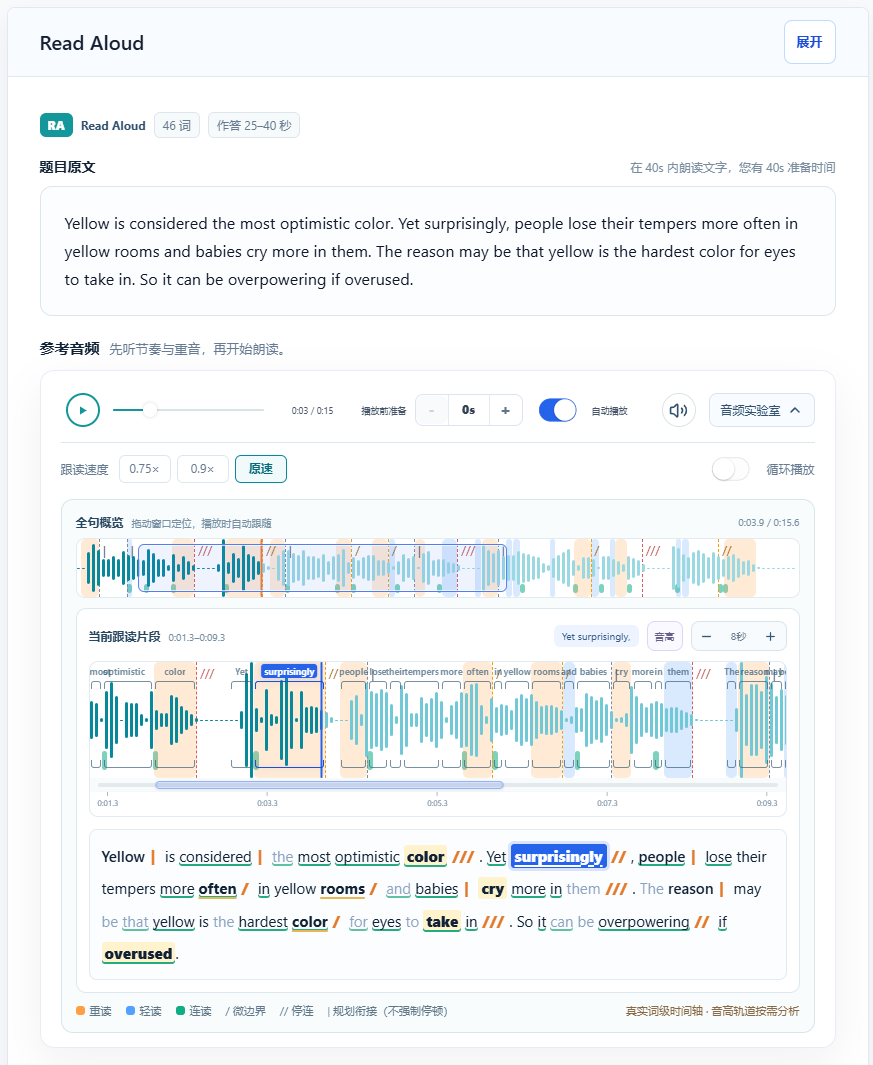
Open Practice → Read Aloud in practice mode, then find Reference audio and expand Audio lab. If the reference audio is still being prepared or loaded, wait until it is available. Compare the prompt and recording through the available feedback, and choose one goal such as fewer long pauses or clearer sentence stress. Pearson officially scores Read Aloud for content, pronunciation and oral fluency; the practice evidence helps choose another attempt, not predict an official result.
Review oral fluency, pace and pauses
Check content first, listen to highlighted pronunciation areas, then inspect the available pace, voiced pace and pause evidence in your recording report. The Audio lab screenshot shows reference-audio waveforms, word timing and rhythm annotations, not a score for your recording. A low-quality recording can affect several signals at once; aim for a natural consistent rate, not maximum speaking speed.
Practise stress, thought groups and sentence rhythm
Use reference audio, full and selected waveforms, short loops, phrase boundaries, stress annotations and supported pitch evidence to practise one meaningful chunk, then reconnect it into continuous speech. Avoid changing five habits in the same attempt. The linked overview is in Chinese; the English Read Aloud guide below explains the next practice cycle.
Regional accents do not need to be erased
Pearson states that regional and national pronunciation varieties are recognised when they remain understandable to regular English speakers. Focus on intelligibility, sound clarity, stress and phrasing rather than imitating one nationality.
Microphone quality can affect practice feedback
Use a reliable microphone, keep a stable distance and reduce background noise. Wait for the recording state, speak naturally and finish without restarting every small mistake. Clipping, echo and unstable recording can alter recognition and timing signals, so keep conditions similar when comparing attempts.
Record again and compare the trend
Repeat the same task or a similar one with the same goal. Look for a consistent change across multiple recordings rather than chasing one unusually high estimate. Use the English Read Aloud guide to plan the next practice and review cycle.
AI speaking feedback is not an official PTE Core score
Lengqishui does not reproduce Pearson’s private scoring engine or issue an official Score Report. Use the evidence to select the next practice goal, never as an immigration result, certification or score guarantee.